Posts

162

I'm sitting myself down tonight after a long baseball season to watch the Cubs for the final time this year. After Ron Santo died last winter, this season I decided to upgrade myself from MLB.com's Gameday Audio to the full MLB.tv package so I'd have access to every Cubs TV broadcast this year. I watched every one . I might not have watched them live, and for quite a number the game became background noise as I worked on something else, but in one way or another I've watched every single game this season. It's not quite like getting season tickets and attending every home game, or like visiting all 30 major league ballparks, but it's something. I certainly didn't pick a memorable Cubs season to watch. Early in the season, an injury-riddled Cubs lineup proved that they were a pretty poor team. Later, when they got healthy, the best they could do was still pretty average. There were way too many blown saves and about a billion men left on base. I know the ...

Why Eleanor Roosevelt Would Have Liked Google+

Image
And why Google+ won't be replacing Twitter or Facebook for most of us anytime soon "Great minds discuss ideas. Average minds discuss events. Small minds discuss people." -- Eleanor Roosevelt I know too much already has been written about Google+ and its place in the world of social networking, but I've recently developed a new perspective which might help some of you who are trying to decide how and when to use Google+ versus Twitter or Facebook. Eleanor might have said "small minds discuss people," but there's more than one way to discuss people and none of us are consistently small-minded. People are important, and the people who are most important to us are those with which we have mutual friendships or family relationships. This is why Facebook is best at people : it enforces (if we ignore fan pages) a symmetric follower model, ensuring that we are connected to people who want to also be connected to us. Those connections, often with people wh...

Fall Semester, 2011

Tomorrow I begin my second year in the doctoral program in the School of Education at the University of Colorado at Boulder. Being a doctoral student isn't quite like being a student at any other level. Doctoral work is more of an apprenticeship, although there are plenty of classes to attend and papers to write. I imagine there are a number of qualities our faculty look for in us doctoral students. During our first year, they see if we can grasp the fundamental methods of quantitative and qualitative research, and they test our understanding of the major political and philosophical issues in our field. During our third year, we'll take a comprehensive exam to measure if we have the focused expertise and vision necessary to go on to pursue work towards a dissertation that will contribute new knowledge to the field. So what do they look for in our second year? If my schedule is any indication, they must be seeing if we can maintain our sanity despite heavy workloads. I hope I...

Time-lapse video of clouds over Boulder

Image
We tend to get a lot of sunny days here along Colorado's Front Range, but right now we're enjoying some much-needed rain. After a couple rainy days earlier this week, the clouds broke Friday morning and we got one clear day before the clouds and rain returned today. Anticipating a nice scene when the clouds broke, I set my Kodak Zi8 on a tripod in my window and let it run. I cut out a 15-minute piece of video using Avidemux  and then used modified code found here and here to prepare the video. First, I extracted two frames from each second of video: ffmpeg -i 2011-05-13-original.mkv -r 2 -f image2 png/%05d.png I then made a text file with the names of all the images and used mencoder to make a 30fps video: ls -1tr > files.txt mencoder -nosound -ovc lavc -lavcopts vcodec=mpeg4:vbitrate=5000 -mf w=1280:h=720:fps=24:type=png mf://@files.txt -o time.avi I then went to Jamendo to get some Creative Commons-licensed music to use the in the background. I chose " ...

Doctoral program year one...done!

Image
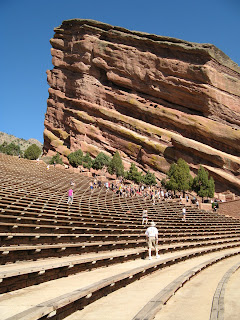
I really don't get excited about the coming and going of school years. In fact, the end of a spring semester always makes me a bit sad. Teachers and students are working at their peak (or their limit), showing off all that they've learned and accomplished and then it just stops and suddenly it's summer. My transition into summer will be smooth, as I'm still working for my advisor and I'll be taking at least one class in July. But I suppose getting this far is an accomplishment in itself. I don't know how much longer it will take for me to finish my doctoral program, but I know I'm now one year closer. Now that we first-year students have some breathing room, my friend Jackie and I headed out yesterday for a photography excursion. Our destination was Red Rocks Park and Amphitheater , located west of Denver near Morrison at the edge of the Rocky Mountain foothills. Red Rocks is, by almost all accounts, the best natural amphitheater in the country, if not one...

How to lose backed-up data (Or: How to have a disappointing day)

I'm pretty thorough about backing up my data. Here's my typical routine: Any school-related files are in Dropbox, so they're available everywhere and backed up. A rsync script cron job makes a new "snapshot" of all my data to an internal 2TB drive inside my computer. The script runs every 8 hours and keeps the 3 most recent snapshots. The same rsync script run manually copies to an external, encrypted 2TB drive that I take to my office. So that's three copies of data in two different physical locations. Good strategy, right? But here's where things go wrong: Remove original boot drive and replace with SSD and fresh Ubuntu installation. Copy old files into /home on new drive. (Now I have 4 copies of data!) Instead of copying everything, directories are moved one-by-one to avoid importing cruft and unnecessary hidden files. Set up rsync script cron job again. (In 24 hours, all the old snapshots are gone. Now I'm down to 3 copies of data again.) ...

March "Matness" 2011

The NCAA Division I wrestling tournament starts tomorrow and I thought I'd throw out a few hastily-chosen predictions for the finals and team race: 125: Robles (AZST) over McDonough (IOWA) 133: Graff (WISC) over Long (PSU) 141: Thorn (MINN) over Russell (MICH) 149: Caldwell (NCSU) over LeValley (BUCK) 157: Taylor (PSU) over Jenkins (AZST) 165: Burroughs (NEB) over Howe (WISC) 174: Reader (ISU) over Lewnes (CORN) 184: Bozak (CORN) over Rutt (WISC) 197: Simaz (CORN) over Foster (OKST) HWT: Trice (CMICH) over Bradley (MIZZ) If any of those finals matches even happen, I'll be shocked. I really didn't spend much time on them, but a Taylor-Jenkins match at 157 could be the story of the tournament (unless Robles wins a title, which I would love to see). Here are my predictions for the team race: 1. Cornell 2. Penn State 3. Oklahoma St 4. Iowa So while the rest of you figure out your brackets of 68, I'll be focused on the 330 wrestlers hitting the mats this...

West Regional 2011

Image
My friend Jordan and I went down to the Air Force Academy today to watch some Division I wrestling action at the West Regional. I went to support my UNI Panthers and, judging by the results, my support wasn't enough. UNI came in second behind Wyoming and UNI only had two champions, Ryan Loder and Christian Brantley. Loder's final over Wyoming's Joe LeBlanc was quite good, with Loder avenging a loss two weeks ago by controlling LeBlanc from the top position in the third period. It was a good match between two very evenly-matched wrestlers. My biggest disappointment came in Brett Robbins' true second match against UNC's Justin Gaethje at 149. Robbins upset Gaethje in the dual last month, and ever since I've been a proud member of the Brett Robbins fan club. Today's rematch was close and the score was tied 4-4 with about 10 seconds left when Robbins was penalized for stalling, giving a 5-4 victory to Gaethje. I don't often dispute an official's call, b...

2010 Year in Review

I think this is the kind of thing most people put in their Christmas letters, but I don't write those. It's also something more organized people manage to write and publish in the last few days of the old year, not nearly a week into the new one. But a lot happened for me in 2010 and I'd like to get it in print before a new semester starts and time slips away. I started 2010 having just applied for the Ph.D program in the School of Education at CU-Boulder. I had already finished a semester of work towards a master's degree, but I knew the opportunity and circumstances were right for me to finally pursue a doctoral degree. I think I was notified of my acceptance in February and in March I participated in the CU's recruiting weekend activities. There I met my new advisor, Finbarr Sloane , a very smart, very hardworking, very enjoyable person who is really helping me develop an interest and expertise in statistics education. The spring semester finished strong with...

Penrith Out at UNI; Who's Next?

I was saddened to hear that Brad Penrith had been fired from his duties as head wrestling coach at the University of Northern Iowa. When Don Briggs was fired after the 1996-1997 season, Penrith was my #1 pick. Fortunately for UNI, we got Mark Manning and Penrith came as an assistant. Manning is a class act, and Nebraska was wise to hire him away. I liked Penrith from day one and was happy to see him take over the job. I liked his humor, how he treated his athletes, and how he treated me. Under Penrith, UNI wrestling had a number of highly successful wrestlers, although team results against top-caliber competition were generally lacking. I was especially proud of UNI wrestling's academic successes, a sign Penrith was recruiting high-quality kids both on and off the mat. UNI did not wrestle well this year, but I understood that Penrith, in year one of a three-year contract, was redshirting some talent and bringing in a good class of recruits in the hopes of having a much stronger te...

Welcome, Google Buzz! Now...where do I comment?

When your engineers have 20% of their time to use on projects of their choosing, you get a lot of interesting product ideas. If nothing else, Google is amazingly unshy about pushing these products and services to their users, even if some start out somewhat incomplete and poorly integrated. Enter Google's newest offering, Google Buzz. Unlike some previous Google attempts at social media, this one is going to work in a big way. First, Google integrated Buzz right into Gmail, the reason most of us have Google accounts in the first place. There are plenty of seats at the Google Labs table, but not many projects get to sit at the front with Gmail. Second, your contact list pre-establishes a social network. Third, if you use Google Profile, you already had established information about yourself and the content you create. Fourth, if you create content with Blogger or Reader, your Buzz account is pre-primed with content. Who else could have done this? Nobody. (Even though Buzz is more ...

Y2K + 10

How's this for an amusing trip down memory lane? Ten years ago, on the eve of the millennium, the big " Y2K ," I was reporting for work in the basement of Gilchrist Hall at the University of Northern Iowa . I was to staff the university's "Y2K Command Center," the strategic hub of UNI's efforts to thwart any disasters due to Y2K. As we now know, very little happened due to Y2K. The fear was that any digital device that recorded dates with only two digits wouldn't know how to properly handle a year "00" and would behave unpredictably. This was a valid concern, but not a surprise so almost all such problems were fixed months ahead of time. Midnight came and went, and things were pretty quiet around UNI. One of our maintenance staff discovered a ventilation fan not working properly (for non-Y2K reasons) and that was it. All the professional staff went home a couple hours after midnight, but Robert Shontz (great student, individual, and c...

I should have asked for ski karma for Christmas

Talk about your epic fail today. I decided several days ago that I wanted to ski Christmas day. I got close, but never made a single turn. Let's look at what turned out to be a waste of a day: I was up before 7, checking the weather and road reports, and it's not exactly great. Chain restrictions at the tunnel and Vail Pass make me think twice about going. All I have is my car, as I don't trust my truck with its bad clutch and oil leak. At about 8:45 I get a positive road report from Lubin, who is headed to Vail from the west. I check some more reports and leave about 9:15. Way too late, but I've left late before and had great afternoons. The roads are certainly passable, but I take it slow and arrive at Vail just after noon. I've heard from some that free parking is hard to find in Vail, but others have assured me that it exists and a bus will take you to the lifts. I explored all of Vail's three exits, and none have signs that clearly point to free parking...

Iowa-to-Colorado Translation Guide

It's not difficult to find Iowans in Colorado. We're everywhere. Even more, I'm sure more Iowans are getting ready to move to Colorado right now. As an Iowan-turned-Coloradoan myself, I thought I should provide this translation guide. Coloradoan says... Iowan hears... Denver Des Moines Boulder/University of Colorado Iowa City/University of Iowa Ames/Iowa State University Fort Collins/Colorado State University Durango Decorah Skiing Wrestling Olathe Sweet Corn Any sweet corn you can buy at a street corner from a couple of kids in the back of a pickup The Post The Register The Gazette The Courier "I spent a winter as a ski bum in Leadville." "I spent a summer as a detasseler in Osage." Denver Broncos Football Aplington-Parkersburg Football (based on fan loyalty and news coverage) Pueblo Chile Frijoles Fest Ackley Sauerkraut Days Mt. Elbert Hawkeye Hill Castle Rock Story City Park Meadows Jordan Creek Vail Oko...

Why Teachers Should Require Students to Use Wikipedia

I've always been a fan of Wikipedia, and often I'm happy to see a Wikipedia entry as my top search result. As a math teacher, I never had many opportunities to direct students in the ways of research, including how to choose appropriate sources. Several of my colleagues who do teach research, however, not only discouraged Wikipedia use, but banned it outright. Why? The most common answer: "Because anybody can edit Wikipedia, students won't know if the information is true." It wasn't until tonight that I saw how shortsighted this reasoning really is, and how it gives students wrong ideas about research. Let's assume we not only encourage, but require students to use Wikipedia. If a student only finds factual information, then we've preserved the status quo, and nothing really changes. But what if the student finds a mistake? (Or, more likely, you find it for them.) This isn't a crisis, this is an opportunity! First, students see this as a ...

The Web of Social Bookmarking

Image
At its very core, linking websites together is what makes the web the web. I've had my own website since 1996, and like many people, we all had a page dedicated to our favorite links. In 2001, my friend Brian Gongol (and he certainly wasn't alone) went a step further and provided not just a list of links, but rather a stream of updates, whether they be sites of interest or news of the day, each complete with Gongol's thoughtful commentary. I liked the idea, and with my adoption of Delicious in 2002, I had an easy way to tag, catalog, and comment on links. Almost 900 links later, I'm still using Delicious, but I'm not sure if anybody has noticed. My RSS feed is picked up by FriendFeed , but not many more people pay attention to it. So what are people paying attention to? Twitter and Facebook , that's what. They each provide audiences I'd like to share with, but neither are good enough to make me leave Delicious behind. Throw Google Reader (my favorite R...

On to the University of Colorado at Boulder!

It's back to school time again, and this year I'll be returning as a student instead of a teacher. While the decision seemed sudden, this has been in the works ever since I left UNI. I was so influenced there by Dr. Bonnie Litwiller, my academic advisor, and Dr. Ed Rathmell, my thesis advisor, that I knew someday I'd want to go to graduate school and pursue higher degrees in math education. But first, for reasons of experience and credibility, I went to Colorado to teach, learn, and explore. Six years later, the time has come to pursue that earlier goal. After evaluating some of the best math education programs in the country, last week I visited CU-Boulder and met with Dr. David Webb. He was extremely generous with his time, working with me for over two hours, and by the time I left we had a plan and any doubts about my decision were gone. Not only is CU-Boulder a great school, it makes sense for me academically, socially, and geographically. So I'm a student aga...

School Compensation Systems: Salaries vs. Grades

Schools reward their inhabitants in two amazingly different ways: teachers get salaries, and students get grades. Not only are these systems vastly different, but I'm not sure teachers would accept a pay scale that's built like a grading scale, nor would students accept a grading scale that's built like a teacher's pay scale. The vast majority of schools pay teachers according to a "salary schedule," a rigid, two-dimensional matrix of dollar amounts with credits across the top and experience down the left side. The more credit hours you've earned, and the more years you've taught, then the more you'll make. I don't feel it's a fair system, but it's a system that most teachers will agree to use, putting it ahead of most any other pay system available. It's a simple system, perhaps too simple. Its simplicity allows us to easily print and read the salaries on a sheet of paper, and I think that's one reason we continue to rely ...

A Look Into the Future (From 1998)

While digging through some old papers, I came across a copy of PC World magazine from January 1998. The headline on the cover reads, "YOUR NEXT PC: What's New for 1998 - and Beyond ." Predictions are fun to make, and more fun to make fun of looking back. Let's see where PC World hit, and where they missed. In one section called "The Desktop Computer in Ten Years," PC World asked Mark Weiser, chief technologist at Xerox PARC what to expect by 2008. Here's his list: The PC will move into a closet, and we can expect gigabytes of RAM and terabytes of storage. Displays will be flexible and you can fold them up in your pocket. Voice recognition will not replace the keyboard and mouse for privacy reasons. Wires will become built into walls and the furniture and we will have wireless mice, keyboards, and phones. E-paper will be standard for everything from books to business cards. We will have "pocket net computers" that allow us to log on to the i...

Switching Back to Kubuntu 8.04 "Hardy Heron"

About a week ago I replaced my well-worn installation of Kubntu 8.04 "Hardy Heron" with the sleeker, newer, Kubuntu 9.04 "Jaunty Jackalope." I hadn't made the jump to Kubuntu 8.10, the first to include KDE 4, because there were plenty of reports about bugs and incomplete features. After waiting through another release cycle, I figured it was time to stop falling behind the tech curve and upgrade. Surely I had been missing something. Instead of finding a bunch of new indispensable features and conveniences, I'm afraid KDE 4.2 is still not ready for my desktop. My biggest gripe? File management. It's not so much a debate between Konqueror and Dolphin, but frankly neither are doing what I want them to do. In KDE 3, I could hover over the icon of a picture, and a pop-up would give me all sorts of good information: date, owner, filesize, image dimensions, and a little bit of EXIF data. Neither Konqueror or Dolphin do that now, although I've read t...